
by Jayne Cravens

NetAid was an anti-poverty initiative, started as a joint venture between the United Nations Development Programme (UNDP) and Cisco Systems. Its web site was www.netaid.org. The initiative no longer exists; the online volunteering portion of NetAid was spun off and hosted by the United Nations at onlinevolunteering.org for many years, but that has now been changed significantly and folded into the over all United Nations Volunteers program.
NetAid was meant to harness the Internet to raise money
and awareness for the Jubilee 2000 campaign, to raise awareness
for the challenges in developing countries, and to allow people
to volunteer online, donating their skills to help people in the
developing world. NetAid's goal was to make global philanthropy
to support developing countries more efficient.
The NetAid web site was launched in September 1999, with
President Bill Clinton, Prime Minister Tony Blair of Britain and
Nelson Mandela, South Africa's former President, logging on.
NetAid was globally launched with concerts on October 9, 1999 at Wembley Stadium in London, Giants Stadium in New Jersey and the Palais des Nations in Geneva. Unlike events like BandAid, ''We Are The World'' and Farm Aid, where wealthy entertainers performed and made pleas for the more fortunate to donate money for those with far less, but after the event, the public's commitment to the cause evaporates quickly, NetAid was meant to be far different. NetAid's organizers wanted to create lasting action and impact.
In an October 7, 1999 New York Times article, Djibril Diallo, then UNDP public affairs director, said ''We want to use the computer to help change how the world looks at poverty and motivate people to help.'' He said UNDP began examining ways of combining music, high technology and altruism more than a year before the NetAid concerts. The article notes that the NetAid web site was meant to be "a clearing house of information on the state of world poverty and the agency's programs as well as a means of raising money." The article quotes Mark Malloch Brown, then head of UNDP, who said ''The difference between this and earlier concerts is that we created a vehicle for people to come back, not just on the night of the concert with the one check they write. But instead, here's a site they're going to come back to time after time.'' The article also noted that the web site "will permit groups and people with particular needs to register them in a Netaid database. It will also allow people who are willing to donate particular skills or materials to register them in the database."
Speaking backstage at Giant Stadium during the concert to a reporter from Wired.com, Robert Piper, described as manager of the NetAid site for UNDP, said: "Our focus is not really just raising money. We're looking for long-term engagement and commitment. If people could donate one day every month it would have quite an impact." After the concerts, in a Washington Post story, "NetAid Catches Few On the Web," Piper said he was "more than satisfied" with the response, saying the main purpose was to pick up volunteers, not money. "We've been [complaining] for years about the need for people in the developed world to participate [in aid programs], but they never had the tools to participate," said Piper. "With the Internet, people can now get emotionally and intellectually involved."
A link to the NetAid site featured prominently on the UNDP web site home
page for many months (screen
capture of the UNDP web site featuring NetAid).
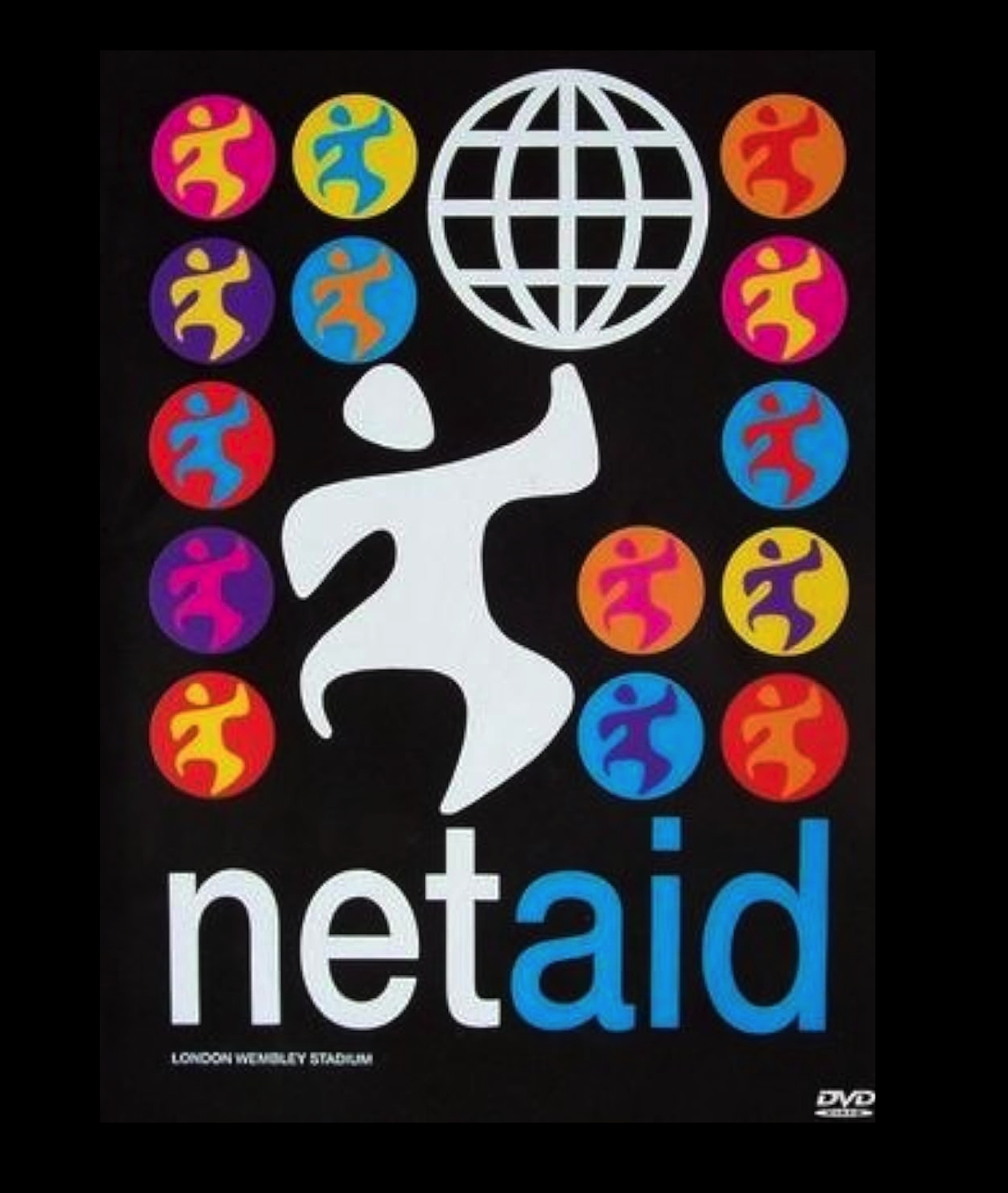 Performers at Wembley Stadium included:
Eurythmics, The Corrs, Catatonia, Bush, Bryan Adams, George
Michael, David Bowie, Stereophonics and Robbie Williams.
Performers at Wembley Stadium included:
Eurythmics, The Corrs, Catatonia, Bush, Bryan Adams, George
Michael, David Bowie, Stereophonics and Robbie Williams.
Performers at Giants Stadium included: Sheryl Crow, Jimmy Page,
Busta Rhymes, Counting Crows, Bono, Puff Daddy, The Black
Crowes, Wyclef Jean, Jewel, Mary J. Blige, Cheb Mami, Sting,
Slash, Lil' Kim, Lil' Cease, and Zucchero.
Performers in Geneva included: Bryan Ferry, Texas, Des'ree and Ladysmith Black Mambazo.
The Wembley show was at capacity; the U.S. show suffered from
very poor ticket sales.
The shows were recorded and released on DVD. There is a
listing for it on Internet Movie Database (IMDB).
In an October 1999 article in the Washington Post, just before the concerts, it was noted that Harry Belafonte, the actor and musician who helped organize the event, and another supporter, actor Danny Glover were quitting the initiative, unhappy at how the event was organized and money raised would be distributed.
By the end of the concerts, it was reported that
the NetAid website had received over 2.4 million hits and
raised $830,000 from 80 countries.
Following the concerts, NetAid was spun out of Cisco as an independent nonprofit, based in New York City. As of August 2000, the Netaid.org Foundation listed as its board of directors: Mark Malloch Brown of UNDP, Don Listwin of Cisco Systems, Carol Bellamy of UNICEF, Quincy Jones and David Morrison.
The staff at NetAid in New York tried various approaches to
raising awareness of extreme poverty and raising money for
anti-poverty projects undertaken by other organizations, through
a variety of different campaigns.
In 2000, NetAid launched an online volunteering matching service on its web site, in partnership with the United Nations Volunteers (UNV) programme, part of UNDP. This was in keeping with the goal of NetAid to create lasting action.
The web site allowed non-governmental organizations (NGOs) and UN-affiliated projects serving the developing world to recruit and involve online volunteers in various projects (virtual volunteering). UNV took over management of the online volunteering portion of the NetAid site entirely in 2001 and, in 2004, the online volunteering portion of the site was relaunched under UNV at its own URL, www.onlinevolunteering.org. This platform continued for many years, allowing any government-registered NGO, nonprofit or charity to recruit online volunteers through the platform. The platform was eventually discontinued and the UN's online volunteering activities were folded into UN Volunteers entirely, and now the online volunteering platform is limited to ONLY United Nations agencies recruiting online volunteers.
In 2000, Charity Village published an in-depth analysis by Graham Francis under the title, "Why did NetAid fail to raise more money from the visitors to its Web site?." In response to these and other criticisms regarding its finances, NetAid published a web page in November 2001 citing its record of donations to anti-poverty initiatives to date, such as granting "$1.4 million to 16 poverty alleviation projects in Kosovo and Africa — well over the $1m that had been raised from the public to that point... the remaining $10.6 million was dedicated to creating an innovative institution that will generate new support for reducing global poverty over the long term. Since January 2000, NetAid has used approximately $2 million to catalyze new support and partnerships for fighting global poverty." See "NetAid's Commitment to Accountability" on the NetAid web site, November 2001, archived from web.archive.org for more info.
In February 2001, Time and NetAid announced a pioneering initiative aimed at collecting donations through Palm VII handheld computers, allowing volunteers to collect credit card data from friends and input the information into the NetAid web site via these newly-wireless devices. The experiment "pushes the envelope for Web-based charities, according to analysts, who said the bid to turn handhelds into virtual wallets faces some significant hurdles--for example, guaranteeing the privacy and security of contributors." See the CNET News article, "Taking donations from the Palm in your hand", by Gwendolyn Mariano, February 2001, for more info.
NetAid also explored the use of video games for social
change, co-founding the Games for Change movement in 2004.
NetAid's work with games was initially offline, beginning with
the "NetAid World Class" board game, which piloted in
California, Massachusetts and New York in 2003. In 2004,
NetAid co-produced a game with Cisco called "Peter Packet,"
which addressed how the Internet can help fight poverty,
focusing on issues of basic education, clean drinking water
and HIV-AIDS.
By 2004, NetAid was promoting an initiative called the NetAid
World Schoolhouse. Even though the online volunteering service
was now being managed entirely by United Nations Volunteers,
NetAid maintained a link to it on the home page.
By 2006, NetAid had again narrowed its focus to raising awareness among high school students in the USA regarding poverty in developing countries.
The different campaigns of NetAid are chronicled through archived versions of its web site, www.netaid.org, available at the Wayback Machine.
In 2007, NetAid became a part of Mercy Corps, a
nonprofit international humanitarian aid organization.
MercyCorps later discontinued the initiative and no longer
promotes the brand.
The best way to research the different programs of NetAid over the years is to look up:
Note that many media archives are behind paywalls. Your local public library or a university library can help you access these for free if you visit the library onsite.
I also have an archive of articles from various publications before the concerts, as well as articles that criticized NetAid. Contact me if you would like access to such. Please give me your complete name, the name of your university or media organization, your geographic location, and the reason you want access.
Also see lessons from
onlinevolunteering.org. This is a list of key
learnings from the UN's Online Volunteering service from
February 2001 to February 2005, including support materials
for those using the service to host online volunteers.
In 2000, UNV created a new position, the Online Volunteering
Specialist, and contacted me,, Jayne
Cravens, to apply for the job. I did so, and began in
the position in February 2001, based at the UNV offices in
Bonn, Germany. I both directed UNV's online volunteering
responsibilities through NetAid and the online materials and
online activities of the United
Nations Technology Service (UNITeS). I
substantially revamped the online volunteering portion of
the NetAid web site, making it much more focused on
helping organizations involve volunteers and to reduce the
number of people signing up for assignments without
understanding that virtual volunteering is a real
commitment (and thereby reducing the number of volunteer
drop outs). You can compare the
August 2000 version of http://www.netaid.org/ov/ to
the August
2 2002 version of http://www.netaid.org/ov/ to see
how I changed the site. I then oversaw the negotiations to
move the online volunteering service entirely to UNV under
it's own URL, www.onlinevolunteering.org.
I authored this list of lessons from
onlinevolunteering.org, based on my experience
directing the service from February 2001 to February 2005.
 The Last Virtual Volunteering Guidebook
available for purchase as a
paperback & an ebook.
Published January 2014.
By Jayne Cravens & Susan
Ellis.
A great deal of what was
learned from managing the UN's Online Volunteering
Service, including when it was a part of NetAid, is
shared in this book. If you are researching NetAid or
United Nations tech-related initiatives, this book is a
must read.
 my home page my consulting services
& my workshops &
presentations my credentials & expertise Affirmation that this web site is
created & managed by a human. My book: The Last Virtual Volunteering
Guidebook contact me or see my schedule Free Resources: Community Outreach, With & Without
Tech Free Resources: Technology Tips for Non-Techies Free Resources: Nonprofit, NGO & other
mission-based management resources Free Resources: Web Development, Maintenance,
Marketing for non-Web designers Free Resources: Corporate philanthropy / social
responsibility programs Free Resources: For people & groups that want
to volunteer linking to or from my web site The Coyote Helps Foundation me on social media (follow
me, like me, put me in a circle, subscribe to my newsletter)
my home page my consulting services
& my workshops &
presentations my credentials & expertise Affirmation that this web site is
created & managed by a human. My book: The Last Virtual Volunteering
Guidebook contact me or see my schedule Free Resources: Community Outreach, With & Without
Tech Free Resources: Technology Tips for Non-Techies Free Resources: Nonprofit, NGO & other
mission-based management resources Free Resources: Web Development, Maintenance,
Marketing for non-Web designers Free Resources: Corporate philanthropy / social
responsibility programs Free Resources: For people & groups that want
to volunteer linking to or from my web site The Coyote Helps Foundation me on social media (follow
me, like me, put me in a circle, subscribe to my newsletter) how to support my work
To know when I have developed a new
resource related to the above subjects, found a great
resource by someone else, published
a
new blog, uploaded a new
video,
or to when & where I'm training or presenting, use any
of the following social media apps to follow me on any of
these social media platforms:


Disclaimer: No guarantee of accuracy or
suitability is made by the poster/distributor of the materials
on this web site.
The information provided on this website is for general
informational purposes only and should not be considered legal
advice.
I am not a lawyer. I am not a legal professional. Do any
information on this site as legal counsel.
I am not responsible for any losses, damages, or liabilities
that may result from the use of this website or reliance on its
content.
Your use of this website and its information is at your own
discretion and risk.
This material is provided as is, with no expressed or implied
warranty or liability.
See my web site's privacy policy.
Permission is granted to copy, present and/or distribute a limited amount of material from my web site without charge if the information is kept intact and without alteration, and is credited to:

Otherwise, please contact me for permission to reprint, present or distribute these materials (for instance, in a class or book or online event for which you intend to charge).
The art work and material on this site was created and is copyrighted 1996-2026